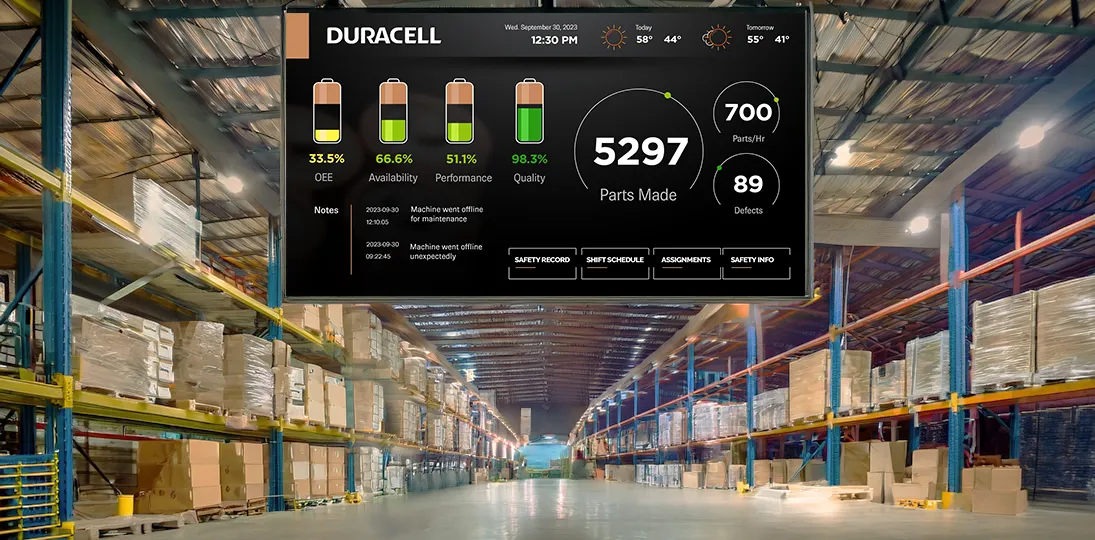
Manufacturing environments are unlike almost any other workplace. The factory floor is loud, physically demanding, and constantly in motion. Workers are focused on production, not checking email or logging into an intranet. Many never sit at a desk. Yet information still needs to reach them: safety reminders, production metrics, HR updates, shift changes, equipment alerts, and more.
That’s a significant communication challenge, and it’s one that traditional methods (printed posters, bulletin boards, overhead PA announcements, and mass emails) have never solved particularly well. Digital signage changes the equation. Strategically placed screens throughout your facility give you a centralized, dynamic, and visually compelling channel that can reach every employee, regardless of where they work or what role they play.
Here are three of the most impactful ways manufacturing digital signage delivers value in production and warehouse settings: improving safety communication, bridging the gap between the front office and the factory floor, and reducing costly downtime.
Safety Communication: More Than Just Posters on the Wall
Let’s start with safety, because in manufacturing and warehouse environments, it’s not just important – it’s critical. The risks in these settings are real and significant. Injuries on a factory floor or in a warehouse can be severe, equipment can be damaged, and the downstream costs are substantial. Conservative estimates place the total cost of a single workplace incident (including lost time, cleanup, insurance increases, and potential OSHA penalties) at around $10,000 – and that number can climb much higher for serious incidents.
Beyond the financial impact, there’s a human dimension to workplace safety that organizations sometimes underestimate. When someone gets hurt, morale suffers. Workers become less focused. If employees start to feel that management doesn’t genuinely care about their wellbeing, disengagement follows, and disengagement creates its own safety risks, feeding a cycle that erodes both culture and productivity.
Effective workplace safety communication has to do more than check a compliance box. It needs to actually reach people, stick with them, and reinforce the behaviors that prevent accidents in the first place.
Why Static Signage Falls Short
Most organizations already have some form of safety signage in place, like OSHA-required posters, bulletin board notices, or laminated procedure guides. These serve a purpose, but they have real limitations. A poster that’s been hanging in the same spot for three months becomes invisible to anyone who walks past it every day. You’ve probably experienced this yourself: there’s a sign you see so often that you practically stop seeing it (or at least no longer take in its details). This is known as the “exposure effect”.
Digital signage solves this with brightness, variety, and motion. Screens change content every few seconds, cycling through a playlist of messages that can be updated as often as needed. That constant variation is what draws the eye, and in noisy environments where workers are moving around constantly, being visually engaging is vital.
Where a printed poster has to deliver one broad, general message to serve everyone who walks by, a digital sign can be targeted to specific locations. The safety reminders on the welding floor don’t need to be the same as what’s displayed near the loading dock or in the break room. You can tailor the content to the specific hazards and procedures that matter most in each area of your facility.
Building a Practical Safety Content Strategy
One of the common hesitations about managing a digital signage system is content volume – the worry that keeping screens fresh requires an enormous ongoing investment of time and effort. In reality, a modern content management system and thoughtful strategy can make the workload quite manageable.
Consider breaking long OSHA checklists or procedural documents into shorter, focused messages. A single regulatory requirement can become a series of simple, memorable reminders rather than a wall of text nobody reads. Using fill-in templates means your safety manager or content creator can produce and schedule a new message in just a few minutes.
Here are some content categories worth including in any manufacturing or warehouse safety playlist:
- PPE reminders: Proper use, maintenance, and inspection of personal protective equipment
- Ergonomics: Posture, lifting techniques, and taking breaks to reduce repetitive stress injuries
- Machinery and equipment: Lockout/tagout procedures, safe operation reminders, inspection checklists
- Slips, trips, and falls: Particularly relevant for warehouses and environments with changing floor conditions
- Training: Training: Training sessions, certification opportunities and renewals, and online resources
- Reporting: Encouraging workers to report near-misses, unsafe conditions, and incidents without hesitation
For warehouses and transportation facilities, content should also address forklift safety, pedestrian traffic zones, loading dock hazards, and hazardous materials handling. The specifics will vary by facility type, but the principle is the same: keep content relevant, keep it fresh, and keep it focused.
Real-Time Data in Your Safety Messaging
One of the most powerful things you can do with digital signage is display live safety metrics. Showing the current “days since last incident” count is a classic example – it’s visible and meaningful, and it reinforces a collective sense of accountability. When that number is climbing, it builds morale and pride. When it resets, it’s an immediate signal to everyone to pay closer attention.
You can pull this kind of data directly into your signage from the systems you’re already using, whether that’s a spreadsheet, a SharePoint dashboard, or another data source. The integration typically requires minimal ongoing effort: once it’s set up, the screen content updates automatically as your underlying data changes.
This same approach applies to safety survey results, training completion rates, and other leading indicators that give employees a sense of where the organization stands and what’s being done to improve.
Bridging the Gap Between the Front Office and the Factory Floor
Manufacturing organizations have a structural communication challenge that doesn’t get discussed as often as safety but can be just as costly: the divide between administrative and production employees.
The office team and the floor workers often operate in what might as well be separate worlds. They’re in different physical spaces, they have very different day-to-day experiences, and they frequently have limited insight into what the other group is doing or dealing with. That distance (both literal and organizational) can breed misunderstanding, erode trust, and make it harder to build a cohesive company culture.
Digital signage can’t dissolve that divide on its own, but it’s a remarkably practical tool for narrowing it.
Making Information Visible to Everyone
Factory floor workers typically don’t have access to company email, an intranet, or even a desktop computer during their shift. For HR updates, policy changes, open enrollment reminders, payroll information – all the routine communications that desk workers receive through digital channels – floor employees have traditionally been left with whatever’s posted on the break room bulletin board or whatever got announced at the shift meeting.
Digital screens in common areas, near time clocks, at entries and exits, and throughout the production floor give those employees the same awareness of company information that their office counterparts get. Payday announcements, benefits enrollment deadlines, schedule changes, recognition of employees who’ve hit work anniversaries – all of this can reach workers where they actually are.
On the flip side, production data and floor-level metrics can be surfaced in the front office as well. When administrators and managers can see production output, order status, and key operational KPIs on screens in their areas, they have a clearer picture of what’s happening on the floor. That shared awareness makes collaboration more natural and decisions better-informed.
Connecting People, Not Just Information
Beyond logistics and data, there’s real value in helping people across different parts of the organization simply know each other better. Short introductory features (like “Get to Know Your Shop Steward”), quick bios of HR staff, spotlights on individual employees and their roles are all simple to produce and can go a long way toward reducing the sense that different groups are operating in silos.
Recognition is another powerful application. Acknowledging employees for safety milestones, production achievements, years of service, or any other accomplishment is one of the most effective ways to build engagement and loyalty. Digital signage makes recognition easy to execute and visible to everyone – not just the manager who wrote the email that most floor workers will never see.
The goal here is using your screens to create a consistent, shared environment where both groups of employees feel informed, included, and part of the same organization. As manufacturing facilities become increasingly integrated with modern networking and automation infrastructure, the expectation from employees is that internal communications will reflect that integration, too.
Targeting the Right Message to the Right Audience
One of the practical advantages of a well-configured digital signage platform is the ability to target specific content to specific locations or screens. Not every message is relevant to every employee. Production numbers might be meaningful context for office staff but noise for workers on the floor who are already living those numbers. Shift change reminders might only need to appear in certain areas at certain times.
This kind of granular control – showing the right thing on the right screen at the right time – is what makes a digital signage system genuinely useful rather than just ambient decoration. It keeps playlists relevant, which keeps viewers engaged, which means your messages actually land.
Reducing Downtime: Connecting Your Data to Your Displays
Downtime is one of the most significant cost drivers in manufacturing. Whether it’s unplanned equipment failures, inefficiencies in production flow, excess inventory, or workers spending time moving around the facility to find information they should have had already, these are losses that compound quickly. Digital signage can address several of these pain points directly – not by doing the work of your ERP or production management systems, but by making the information those systems generate visible and actionable on the floor in real time.
This is where the data integration capabilities of digital signage really shine. Most platforms can pull from Excel spreadsheets, XML feeds, JSON data sources, or direct database connections, so the displays stay current on their own once the integration is in place.
Visualizing Lean Manufacturing Principles with DOWNTIME
Of course, you’re familiar with the idea of downtime, but what about the acronym DOWNTIME? This stands for eight waste categories central to Lean manufacturing: Defects, Overproduction, Waiting, Non-utilized talent, Transportation, Inventory, Motion, and Extra Processing. Digital signage can help with each one of these items.
Defects
Extra costs are incurred when a part has to be reworked, or production needs to be rescheduled or repeated, since these costs can’t be passed on to the customer and so are taken as a loss. Showing real-time data on your big screens keeps everyone informed as to where defects are occurring, so you can adjust raw materials and improve the design of the production process (altering or eliminating steps as needed).
Overproduction
It may seem efficient to assemble more items than are currently on order, but this leads to excess inventory, which must be stored and catalogued, which can lead to inefficiencies in many other areas. The ideas of just-in-time, short-cycle, and continuous-flow manufacturing are all attempts to address this area of waste. Managers can also leverage digital signage to pull data and track batch sizes compared to orders pending, keeping product flow lean, and communicating everything to the relevant workers.
Waiting
This covers not just finished products waiting to be shipped, but components of products waiting to be used or integrated. Display the time it takes from when an order is placed to when the product is actually shipped, with targets and progress towards those goals. Show current and anticipated work orders, pulling the information from your databases into your digital signage software. Workers can then see changes as they occur in real-time, and no one needs to write reports because you already have the information correlated in a concise and visual manner.
Non-utilized Talent
Your employees may be unmotivated. Maybe they aren’t invested enough in the products you offer, or they don’t feel like the company cares about them. Your digital signage can display messages about your company’s core values and beliefs, inspirational quotes, and communications from top management about why they do what they do. Many modern employees also feel that transparency is important, so show reliable metrics on how the company is performing. Reminding employees about company events and their benefits packages also helps them feel like they are being taken care of.
And while your employees may have been hired for a specific skill set, they probably have a lot more to offer your company. Use your screens to promote innovation incentives and training opportunities or allow the workers themselves to have access to system, so they can post messages, sharing and pooling their knowledge and interests with one another. When management sees something that looks appealing, they can use it to make the entire process more efficient, and reward employees for thinking outside the box.
Transportation
Whenever products or materials are physically moved, there’s a risk of damage, loss, or delay. Digital signage allows real-time communication between inventory and logistics, letting people see trends in inventory and transportation through stats and data visualizations. This allows them to fine-tune their processes to optimize where things are and where they need to be, minimizing the distances required to move them.
Inventory
Any inventory that is sitting around not being used is not producing income. This could be finished goods, works-in-progress, or raw materials. But not having enough on hand also leads to inefficiencies. Displaying stock numbers, production schedule changes, and fabrication goals lets everyone work together to make sure that inventory is maintained at optimal levels.
Motion
The production process itself involves moving things and people, with attendant damage – wear and tear on equipment, repetitive stress injuries for workers, and accidents that damage both machinery and people. Using digital signs throughout your facility to show regular safety reminders and up-to-the-minute metrics on machinery maintenance needs can reduce these problems.
But there’s another inefficiency in motion: people going from one location to another. Because displays can be put wherever you want them, and you can target a single building or even a single screen, you can send the right messages to the right people, reducing their need to go elsewhere to get the information they need. And your displays can keep up a constant stream of relevant, easily accessible information, so no one forgets or overlooks something.
Extra Processing
When you do more work on a product than the customer needs, or your components are more complex or more expensive than they need to be, then there’s waste. Again, current messaging that shows up-to-the-minute data lets floor managers see where this is happening and correct accordingly.
Use your digital signage to remind workers of the exact steps to get your product where it needs to be, the quality assurance checks it will go through, and when they can move on to the next project.
Be sure to recognize employees and work teams for decreasing waste, increasing safety, and improving productivity. By using digital signage to keep everyone informed, updated, and engaged, you can reduce downtime and increase morale.
Putting It All Together
The three areas we’ve talked about – safety, organizational cohesion, and operational efficiency – aren’t really separate problems. They’re interconnected facets of the same underlying challenge: communication in a complex, distributed, physically demanding environment.
Digital signage addresses all three from a single platform. One system, centrally managed, can deliver targeted safety content to every corner of your facility, bridge the information gap between the office and the floor, surface real-time operational data to the workers who need it, and recognize the people who make it all happen. The flexibility of modern digital signage platforms means the content strategy can evolve with your organization, starting simple and growing in sophistication as you see what resonates with your workforce.
For IT teams evaluating solutions, the key capabilities to look for are reliable data integration (so screens can pull live information from your existing systems), granular scheduling and location targeting (so the right content reaches the right audience), and an interface that empowers content managers (whether they’re in the communications department, HR, or EHS) to create and update messages without needing technical assistance every time.
For business leaders, the value proposition is straightforward. Better communication means a more engaged workforce. A more engaged workforce means fewer safety incidents, less turnover, stronger operational performance, and a healthier culture. Digital signage is one of the more concrete, measurable investments you can make in all of those outcomes simultaneously.