Every organization with more than one location runs into the same communications problem: a single message rarely fits every audience. What matters to your headquarters team in Atlanta may mean nothing to the people in your Prague office, and a message built for the day shift can fall flat with the crew that works overnight. Localized content solves this by adapting what appears on your screens to the people actually standing in front of them, without losing the consistency of your overall brand.
This guide brings together practical, tested ways to localize your digital signage software content across multiple locations, teams, and shifts, so every screen feels like it was made for the audience watching it.
What Localized Digital Signage Content Really Means
Localization is often mistaken for translation, but it goes well beyond swapping one language for another. At its core, localization means adapting communications to the specific location, culture, and audience you are trying to reach. It touches everything from word choice and imagery to which stories get told and when they appear on screen.
Language Is Just the Starting Point
If your headquarters is in Shanghai, displaying signage in Mandarin at a Pittsburgh office helps no one; the message becomes noise, and noise gets ignored. So, translation matters, but it is only the entry point. Once the words are understandable, the next question is whether the content itself is relevant to the people reading it.
Relevance Beats Reach
Employees in Pittsburgh do not need updates about office construction in Chicago, and night shift workers do not need midday commute traffic reports. Content that ignores these distinctions trains your audience to tune out the screen entirely. Once viewers write off your signage as irrelevant, even the messages that do matter to them get lost.
Why Localized Content Drives Employee Engagement
Communication and community go hand in hand, and both are essential to a workplace where people feel informed and valued. Localized signage is one of the most direct ways to build that sense of belonging, because it shows employees that your organization sees them as individuals rather than as a line item on a distribution list. For a deeper look at what keeps people watching and reading, see our guide to digital signage employee engagement.
Localized messaging also reinforces something bigger than any single announcement: it tells your audience that leadership understands the difference between their office and every other one on the network. That distinction builds trust, and trust is what turns a screen people glance at into a channel people actually rely on.
Balancing Global Brand Standards with Local Messaging
None of this means abandoning your global brand. In fact, the opposite is true: local content works best when it stays visually consistent with the rest of the organization. A shared color scheme, tone of voice, and layout give every location the credibility of the larger brand, while the words and stories on screen flex to fit the local audience.
Think of it as a balance between two owners. Corporate is responsible for the brand standards, templates, and company-wide initiatives that keep every location recognizable. Local teams are responsible for knowing their own audience, from shift schedules and regional holidays to which announcements will actually land. Neither side should be passive, and the best signage networks give local teams real ownership within a consistent framework.
Practical Ways to Localize Digital Signage Content
Here are five proven approaches for putting localization into practice across a distributed signage network.
Spotlight Local Leaders and Teams
Promote a culture that values both individual and group contributions at each location. Spotlighting the people who land a big contract, streamline a process, or step up during a last-minute change gives every office its own local heroes, not just a corporate list of company-wide award winners. Recognition like this helps you retain your best staff, wherever they happen to work.
Streamline Room and Meeting Information
Coordinating meetings across a busy day is hard enough without also hunting for an open room. Meeting room signs show real-time schedules and availability for each specific location, and changes sync instantly across every connected display, so local staff always see accurate, location-specific information rather than a generic company-wide calendar.
Communicate Real-Time Local Updates
Weather delays, road closures, and last-minute changes look different depending on where your office sits. A storm warning that matters in Charlotte is irrelevant in Prague, and vice versa. Localized content lets each office get the specific, timely information its people need to plan their day, whether that is travel conditions ahead of a trip to headquarters or an emergency notification for the building they are standing in.
Prepare Each Location for Change
Organizational change lands differently depending on the office. Use video and slideshow content on your screens to explain how an upcoming shift, whether it is a new process, a merger, or a policy update, will affect each location specifically. Framing change in terms that are locally relevant reduces anxiety and builds understanding faster than a single company-wide memo ever could.
Build Local Community Connections
An organization is also part of the community around it. A free concert in the local park, a discount at the gym down the street, or a shout-out during a local holiday all show that your organization cares about more than just the bottom line. These small, local touches, paired with company-wide messages like a global recognition of a shared holiday, help knit a multi-location organization into one cohesive culture without erasing what makes each location unique.
Building a Localization Plan for Your Digital Signage Network
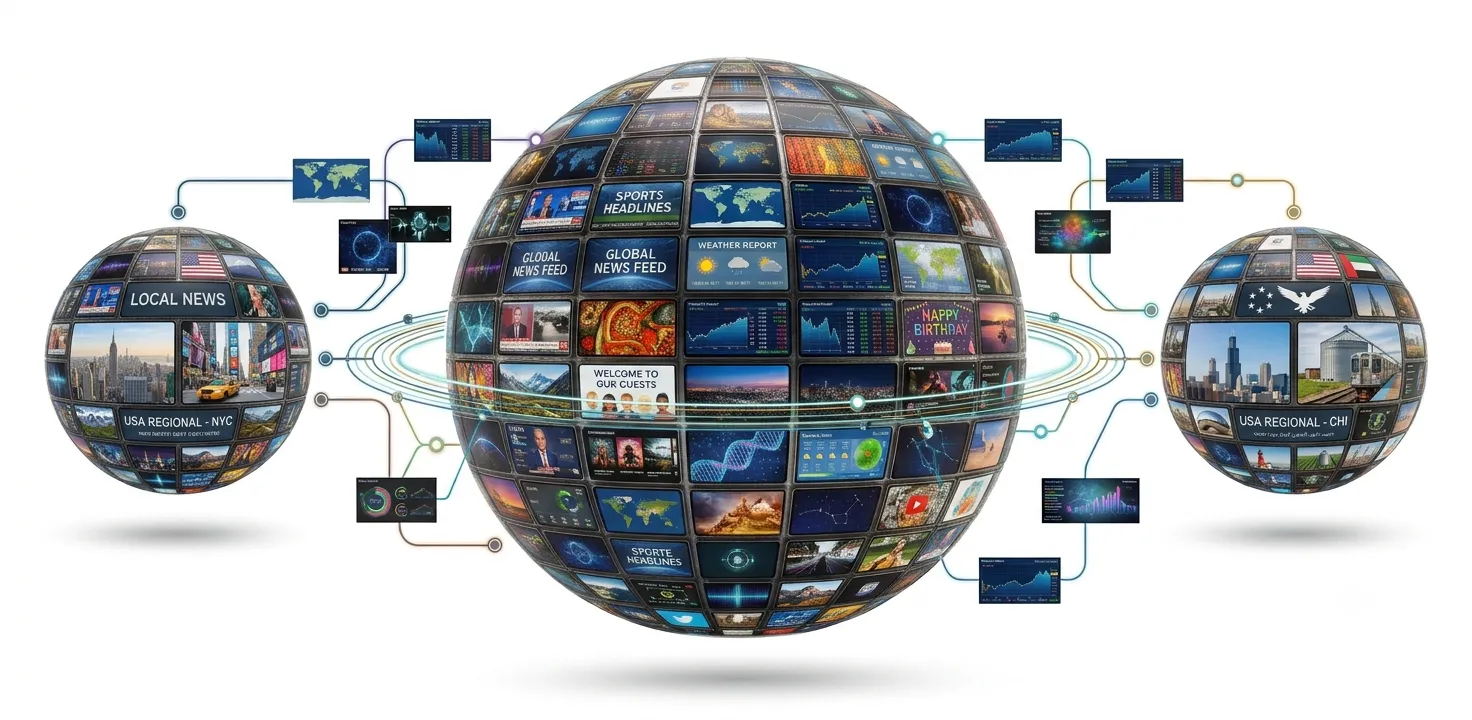
Localization works best when it is planned rather than improvised. Decide which content is global, which is regional, and which is hyper-local, and map out how each type reaches the right screens. Our digital signage content plan walks through how to organize your content calendar, assign ownership, and keep every location’s screens fresh without overwhelming the team responsible for managing them.
A solid plan also accounts for dayparting, so third-shift workers see information relevant to their hours instead of a playlist built for a nine-to-five office, and for audience-specific targeting, so a university’s student deadlines never show up on a screen only staff will see.
Get Started. Go Local.
Localizing your digital signage does take a bit more planning than a one-size-fits-all broadcast, but the payoff is real: higher engagement, stronger trust, and a workplace culture that feels considered rather than generic. Visix digital signage apps give you the tools to manage global brand standards and local content from a single platform, so every office, shift, and team sees exactly what matters to them.
Want to hear more on this topic? Listen to our podcast conversation, Localization & Why It Matters.