Key Takeaways
- Engagement is in measurable decline, and the cost is real. Gallup’s State of the Global Workplace: 2025 report puts global employee engagement at 21%, down from 23%, with an estimated $438 billion productivity loss, making engagement a board-level concern rather than an HR initiative.
- Facility managers shape the daily employee experience more than they’re typically credited for. The physical environment, and the communication infrastructure embedded in it, either reinforces engagement each day or quietly erodes it.
- Digital signage maps directly onto all 11 IFMA core competencies, from Communication and Leadership to Emergency Preparedness, Sustainability, and Human Factors, making it one of the few investments that supports the entire FM mandate simultaneously.
- The ROI is documented and consistent. Industry research from 2025 shows 25-27% engagement lifts, 20-25% gains in internal communication efficiency, up to 15% better retention from on-screen recognition, and, in manufacturing, 41% fewer quality defects with $4-6 returned per $1 invested in safety communication.
- Deskless and frontline workers are the biggest opportunity. Only 29% of non-desk employees are satisfied with internal communication, versus 47% of desk-based staff. This is a gap that email, intranets, and Slack cannot close, but that digital signage in break rooms, corridors, and operational areas can.
- Modern signage is a technology platform, not a billboard. Integration with calendars, BI dashboards, HR systems, scheduling tools, social feeds, and CAP-triggered alert systems turns each screen into a hub that supports operations, safety, wayfinding, and culture at once.
- Engagement priorities vary by facility type. Corporate campuses focus on hybrid-era visibility and recognition; hospitals reach clinical staff who never sit at desks; universities coordinate across dispersed buildings; government offices serve dual audiences; manufacturing and warehouse environments see the clearest measurable returns.
- Recognition, purpose, and visible values are the strongest engagement levers and digital signage delivers all three consistently. Employees with a strong sense of purpose are 5.6 times more likely to be engaged, yet nearly half of employees today can’t articulate their organization’s core values.
- Content, not hardware, determines success. Screens become valued daily channels only when content is designed, written, and refreshed deliberately, with each screen mapped to a defined audience and purpose.
- The strategic takeaway for facility managers: digital signage is one of the few tools that simultaneously satisfies the IFMA framework, reaches the populations other channels miss, and produces measurable engagement gains, positioning the FM function as a direct contributor to retention, productivity, and culture.
Digital signage helps facility managers improve employee engagement by reaching deskless workers, reinforcing recognition and purpose, and consolidating communication across the eleven IFMA core competencies. Industry data from 2025 links workplace digital signage to a 25% to 27% engagement lift, 20% to 25% better internal communication efficiency, and up to 15% better retention through on-screen recognition.
Digital signage for facility managers has quietly evolved from a wayfinding tool into one of the most effective channels for employee engagement in 2026. The buildings you oversee are no longer just spaces where work happens; they are themselves communication platforms, culture-shaping tools, and competitive differentiators in a workforce that increasingly judges employers by the daily experience of being on-site. This directly affects how engaged workers are, which in turn affects productivity, retention, safety, and the quality of service those facilities deliver.
Yet, recent numbers tell a sobering story. Gallup’s State of the Global Workplace: 2025 report found that global employee engagement fell from 23% to 21% in 2024, the sharpest year-over-year decline since the pandemic. The estimated cost of that disengagement: roughly $438 billion in lost productivity in the US, with global estimates from Gallup placing the figure closer to $10 trillion when measured against potential output. For every kind of organization or facility – hospitals, universities, government offices, libraries, manufacturing plants, warehouses – investing in engagement has become a necessity.
This is where facility managers have a meaningful, often underestimated role. The International Facility Management Association (IFMA) identifies 11 core competencies for the profession, and digital signage touches every one of them. More importantly, when deployed thoughtfully, it directly addresses the key findings in engagement research: employees feel more motivated, more informed, and more loyal when they receive frequent, visible, relevant communication from their organization. Research from Trade Press Services, widely cited in the internal communications field, found that 85% of employees report feeling more motivated when leadership keeps them updated on company developments, and workplaces with effective internal communication are four times more likely to report high engagement levels.
Digital signage is one of the most reliable ways to put that communication in front of people who don’t sit at desks, don’t open the all-staff email, and don’t visit the intranet.
It’s also worth grounding the business case. Recent industry data on workplace digital signage points to consistent, measurable outcomes:
- Digital signage in offices, warehouses, and break rooms is associated with a 25% to 27% increase in employee engagement, according to multiple 2025 industry analyses aggregated by Market.us and SeenLabs.
- Internal communication efficiency improves by 20% to 25% when digital signage is part of the channel mix (Gitnux, 2025).
- Employee recognition delivered on screens has been linked to retention improvements of up to 15% (Gitnux, 2025).
- In manufacturing environments, digital signage has been associated with 22% higher engagement and a 41% reduction in quality defects, with safety communication returning $4 to $6 for every $1 invested.
- Surveys of internal communications professionals indicate that 56% of teams plan to increase their investment in digital signage in 2025-2026, and roughly half already use it as a primary channel.
For facility managers, those figures translate into a defensible budget conversation. Engagement is not a soft concept; it is tied directly to productivity, retention, safety outcomes, and – in healthcare, manufacturing, and public sector facilities – the quality of service delivered to patients, students, or citizens.
The remainder of this article looks at how digital signage works within the IFMA framework, then looks at the practical realities facility managers face across different facility types.
Mapping Digital Signage to the IFMA Core Competencies
IFMA’s 11 core competencies define the global standard for facility management. And for each one, digital signage can offer a distinct contribution to employee engagement.
Communication
Communication sits at the top of the list for good reason. Digital signage placed in lobbies, corridors, break rooms, cafeterias, elevator banks, and high-traffic operational areas reaches more people, more reliably, than any other internal channel. Unlike email or intranet posts, it requires no log-in, no action from the viewer, and no inbox to compete with. Content can be differentiated by location: public-facing screens in lobbies and reception areas can show visitor-appropriate messaging, while back-of-house screens in break rooms, locker rooms, and operations corridors carry staff communications, recognition, and operational updates.
This is particularly important in light of a persistent communication gap. Research published in Staffbase’s 2025 International Employee Communication Impact Study found that only 29% of non-desk employees described themselves as satisfied with the quality of internal communications, compared to 47% of desk-based employees. For hospitals, manufacturing facilities, warehouses, universities, and government offices (all of which have substantial non-desk populations), digital signage closes a gap that no other channel reliably addresses.
Leadership and Strategy
An enterprise-grade content management system gives a facility manager a centralized platform from which to publish to a single screen, a building, a campus, or facilities in multiple cities. That centralization is itself a leadership demonstration: it shows that the organization is investing in a modern communications infrastructure rather than relying on printed memos, bulletin boards, and emails. For executives, the ability to see consistent messaging across all locations – mission, values, strategic priorities, town hall recaps – signals organizational alignment in a way that is difficult to achieve through any other medium.
Finance and Business
Digital signage is a relatively predictable line item once the initial system is in place. When budgeting, facility managers should evaluate the full cost picture: software licenses (on-premise or cloud), media players, displays, content creation and refresh, support subscriptions, and likely future expansion. Hardware-as-a-service and subscription models have become widely available and can shift the investment from capital to operational expense, which often simplifies internal approval processes. Replacing printed notices with digital displays has been shown to reduce printing costs by around 30% (Gitnux, 2025), and the labor savings on posting, removing, and replacing physical signs are real but rarely accounted for until digital signage is in place.
Quality
Quality outcomes improve when people can see, in real time, how they are performing against expectations. Production floor screens that display shift output, defect rates, on-time delivery percentages, or patient satisfaction scores create the kind of visible feedback loop that motivates teams to push toward targets. The same screens can prompt direct input from employees through QR codes linking to pulse surveys or suggestion forms, turning passive viewing into a two-way conversation. Compliance reminders, policy updates, and code adherence are also more effective in short, visually engaging formats on screens instead of as PDFs buried in an HR portal.
Technology
Modern digital signage is not a billboard. It is a technology platform that integrates with calendars (Exchange, Google, EMS), HR systems, business intelligence dashboards, social media feeds, RSS, weather services, and queuing or reservation systems. Interactive touchscreens can deliver directories, wayfinding, and self-service look-ups. Mobile wayfinding applications extend the signage system into employees’ and visitors’ pockets, providing turn-by-turn directions and contextual content as they move through a facility. For facility managers evaluating where to invest in technology over the next three to five years, signage is one of the few categories that touches communications, operations, safety, and space management simultaneously.
Operations and Maintenance
Occupant services and day-to-day operations benefit visibly from digital displays. Tenant and department directories, cafeteria menus, shuttle schedules, parking availability, helpdesk hours, and concierge information can all live on screens placed where people actually need them. Interactive kiosks can augment or partially replace front-desk staff, freeing reception teams to focus on personalized service for visitors who genuinely need it. In a hospital, that might mean directing patients to specialist offices while a receptionist focuses on a family in distress. On a corporate campus, it might mean self-service visitor check-in while a host attends to a high-priority client.
Meeting and shared-space management is another operational area where signage pays off quickly. Digital room signs pull live data from scheduling platforms, display current and upcoming bookings, and, on interactive models, allow ad-hoc reservations directly at the door. Newer ePaper desk and room signs are wireless, battery-powered, and easy to mount in any shared space, which makes them well suited to hot-desking, office hoteling, and the hybrid workplace patterns now common in corporate and government environments. The time savings are tangible: industry estimates suggest digital signage saves employees roughly 15 minutes a day in information retrieval, room hunting, and routine logistical friction. That works out to five hours a month being saved simply by using these technologies. Per person.
Human Factors
This is where the engagement story most directly comes together. The human factors competency is about creating an environment that supports recruitment, retention, motivation, and productivity, which are also exactly the outcomes engagement programs are designed to drive. Digital signage contributes in several ways:
- Recognition. Employee-of-the-month features, service anniversaries, project shout-outs, and team wins on display screens give recognition a visible, repeatable rhythm. Research has consistently shown that recognition is one of the strongest engagement drivers; one widely cited study found that recognition can increase engagement by as much as 69%.
- Purpose and values. A 2025 Gallup study with Stand Together found that employees with a strong sense of purpose at work are 5.6 times more likely to be engaged. Yet other research suggests that nearly half of employees can’t articulate their organization’s core values. Screens that consistently reinforce mission, values, and customer or community impact make purpose visible.
- Wellbeing. Reminders about EAP resources, mental health support, mindfulness sessions, financial wellness programs, and safety initiatives signal that the organization is paying attention to the whole employee.
- Connection. Screens can carry social-media-style content from internal channels, photos from team events, and cross-department spotlights that help employees see themselves as part of a larger organization. This matters especially in distributed or shift-based environments where colleagues rarely cross paths.
For facility managers leading engagement-adjacent initiatives, the practical implication is that the screens you install are not just operational tools: they are part of the daily experience that shapes how employees feel about their employer.
Emergency Preparedness and Business Continuity
A comprehensive emergency plan should integrate digital signage as a primary alert channel. Most enterprise systems support manual overrides, scheduled drills, CAP (Common Alerting Protocol) triggers, and API integrations with third-party emergency notification systems. Color-coded alerts (severe weather, fire, lockdown, hazardous material, medical) paired with short, glanceable instructions can be triggered systemwide, by building or by zone. In healthcare, that means activating code procedures across only the affected floor. In a manufacturing or warehouse environment, it means evacuating only the building where the incident is occurring without disrupting operations elsewhere. In a university or government facility, it means delivering location-specific guidance during an active threat.
This capability is also an engagement signal in its own right: employees who see that their employer has invested in clear, fast, reliable safety communication are more likely to trust the organization’s stewardship of their wellbeing.
Real Estate and Property Management
Web-based signage software allows authorized users at any location to update content from any internet connection. Active Directory or single sign-on integration controls who can publish what, and where. A regional facility director can manage 30 buildings from one console; a local site lead can update only their own location’s content; corporate communications can push organization-wide messaging that overlays local content. For organizations managing diverse property portfolios – universities with multiple campuses, healthcare systems with networked hospitals and clinics, manufacturers with distributed plants, or government agencies with offices across jurisdictions – this hierarchical control is essential.
Project Management
For internal teams as well as cross-functional projects, signage can carry progress dashboards, milestone trackers, SharePoint and Teams content, and data pulled directly from spreadsheets or business intelligence platforms. Everyone sees the same information at the same time, which reduces the “wait, when is that due?” friction that consumes meeting time and email threads. For facility management teams themselves, screens in operations centers can display work order status, preventive maintenance schedules, and KPI dashboards, turning the FM operation into a more transparent, accountable function.
Environmental Stewardship and Sustainability
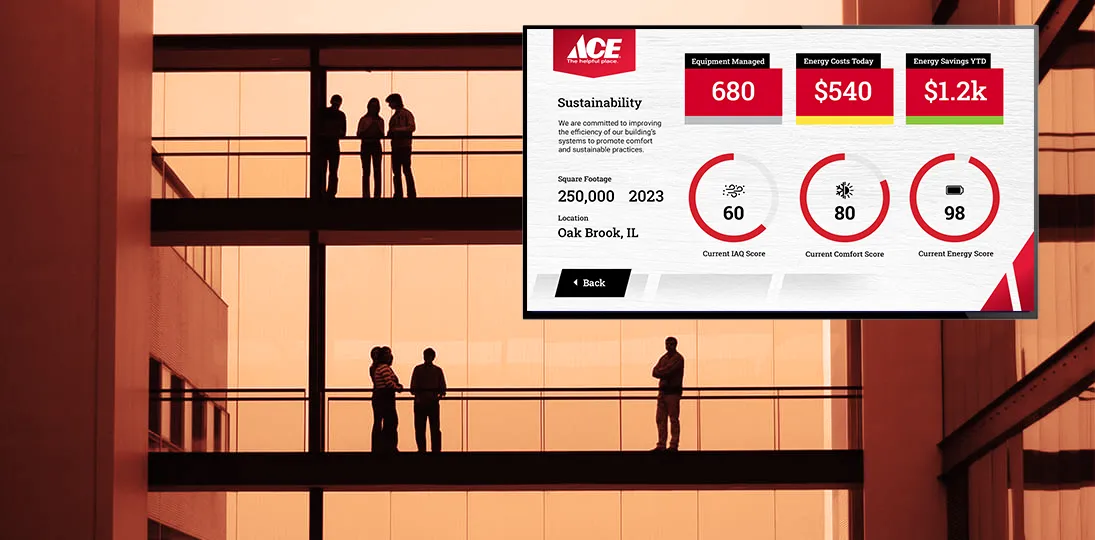
Sustainability initiatives gain visibility and traction when they are part of the daily visual environment. Energy dashboards that show real-time utility consumption, water usage, and recycling rates make abstract goals concrete. Reminders to turn off unused lights, close fume hoods in labs, or properly sort waste are far more effective on screens than as one-time emails. Beyond content, the medium itself contributes: replacing printed signage, memos, and bulletin board postings reduces paper consumption, and modern displays operate at very low power, particularly ePaper room signs. For organizations reporting on ESG metrics, the move from paper to digital is a documentable improvement.
Engagement Considerations by Facility Type
The IFMA framework applies across facility types, but the engagement priorities can differ somewhat.
Corporate Offices and Campuses
Hybrid and flexible work arrangements have made physical presence more deliberate. Employees who come into the office want it to be worth the trip. Digital signage that surfaces team activity, leadership messaging, event announcements, dining options, and recognition turns the office into a place that rewards attendance rather than simply requiring it. According to Gallup, hybrid workers consistently report the highest engagement of any work arrangement, and the in-office experience is part of why.
Hospitals and Healthcare Facilities
Clinical staff rarely sit at desks, and shift patterns mean that important information often misses people entirely. Digital signage in break rooms, locker rooms, nursing stations, and corridors keeps clinical and support staff informed about policy changes, infection-control updates, recognition, wellness resources, and patient experience metrics. The same infrastructure supports visitor wayfinding and family communication in public areas, which is an operational efficiency that has direct effects on staff workload.
Universities and Colleges
Faculty, staff, and student workers are spread across campus, in academic buildings, residence halls, athletics facilities, and administrative offices. Digital signage networks simultaneously handle institutional news, event promotions, emergency alerts, and wayfinding. For facilities and operations staff specifically, signage in maintenance shops, mailrooms, and dispatch areas keeps a dispersed workforce aligned and on track.
Government Offices, Courts, and Chambers of Commerce
Public sector facilities serve both employees and citizens, and digital signage handles both audiences without conflict. For staff, screens carry policy updates, training reminders, and recognition. For visitors, the same network manages directories, queue information, and wait times. Emergency communication is a particular priority in courts and public buildings.
Libraries
Library staff are often distributed across branches, and engagement initiatives are easy to overlook. Internal-facing screens in staff areas keep branch teams connected to system-wide messaging, while public screens handle program promotion, hours, and community announcements.
Manufacturing Facilities and Warehouses
These are the environments where digital signage often delivers its clearest, most measurable returns. Production metrics, safety reminders, shift changes, and recognition reach a deskless workforce that has no other reliable channel, digital or otherwise. The 22% engagement improvement and 41% defect reduction figures cited earlier come specifically from manufacturing environments. Add real-time injury rate reductions of around 20% and the case is straightforward.
Where to Start
For facility managers evaluating or expanding a digital signage program with engagement in mind, a few practical points are worth keeping in front of executive sponsors:
- Treat content as a budget line. The hardware and software are the easy parts. Content is what determines whether a screen becomes a valued daily channel or background noise, and that needs to be designed, created, and refreshed. Plan for it.
- Map screens to audiences, not to walls. Every screen should have a defined audience and a defined purpose. A breakroom screen for warehouse staff has a different content mix than a lobby screen for visiting clients.
- Reach the unreached. Prioritize placements that serve frontline and deskless workers first. They are the population most underserved by other internal communication channels and the population where engagement gains are typically the largest.
- Integrate, don’t isolate. Connect signage to the systems employees already use, like calendars, BI dashboards, HR platforms, scheduling systems, and alert systems. The goal is to consolidate into fewer information silos, not create another one.
- Measure. Pulse surveys delivered via QR codes on screens, attendance at promoted events, room-booking efficiency, and recognition program participation all provide measurable signals. Engagement is too important to leave unmeasured.
Closing Thoughts
Digital signage is one of the few tools that maps directly onto the IFMA core competencies while also producing visible, measurable improvements in the employee experience for facility managers.
Employee engagement in 2026 is harder to earn than it was a decade ago. The competition for attention is fiercer, the expectations are higher, and the cost of inattention – measured in turnover, lost productivity, and quality failures – is well documented. Facility managers sit in an unusual position: they control the physical infrastructure where engagement is either reinforced or quietly eroded each day.
The screens on the walls are not the point. The point is what they make possible: a workforce that knows what is happening, sees that it is recognized, understands where the organization is going, and feels that the people responsible for the building are also responsible for them.