For most of the last century, donor recognition followed a familiar formula: a wall in the lobby, rows of engraved brass or etched glass plaques, names organized by giving tier. It was dignified; it was permanent. But was also static, expensive to update, and limited in what it could actually communicate about the people whose generosity built it.
Digital donor boards change that calculus. Often running on the same digital signage platform that powers your lobby displays, wayfinding kiosks, and internal communications screens, they turn donor recognition into a living, dynamic communication channel. Donors get richer recognition. Prospective donors get a clearer picture of your mission and its impact. And the people responsible for maintaining the system, often whoever has been handed the keys to the organization’s digital signage, have an easier time of it.
This guide pulls together what we’ve learned about planning, deploying, and managing digital donor boards: the case for going digital in the first place, the benefits that matter most, and the practical considerations that make the difference between a polished installation and a project that stalls out.
Charitable Giving Is Growing, and So Is Competition for Donors
Before we dig into the boards themselves, it’s worth grounding the conversation in numbers. Charitable giving in the United States hit a record $592.5 billion in 2024, a 6.3 percent increase in current dollars over the year prior (3.3 percent when adjusted for inflation), according to the Giving USA 2025 report. Individuals were responsible for the largest share, roughly two-thirds of total giving, or about $392.45 billion. Corporate giving climbed 9.1 percent to $44.4 billion, foundation giving reached $109.81 billion, and bequests came in at $45.84 billion.
Those numbers tell a story of resilience and growth, but they also tell a story of competition. With well over a million 501(c)(3) organizations in the U.S. alone, and most donors supporting multiple causes per year, recognition and engagement are no longer optional niceties. They are part of how organizations retain donors and attract new ones in a crowded field. The same dynamic plays out in higher education, healthcare, NGOs, and public-private entities, all of whom lean on donations to fund work that government and earned revenue can’t fully cover.
What Is a Digital Donor Board?
At its simplest, a digital donor board is a screen (or set of screens) dedicated, fully or in part, to donor recognition. It’s typically located somewhere with foot traffic: a lobby, a hospital atrium, a campus visitor center, or a museum vestibule. It can be a standalone project or managed through your digital signage software the same way you’d manage any other display in your network.
That last point is worth pausing on. A donor board isn’t a separate technology stack. If you’ve already invested in a CMS for digital signage, the donor board is one more endpoint on the same system: same content management, same scheduling, same user permissions, same media players. For IT teams, that’s a meaningful detail. You’re not standing up a parallel infrastructure or training people on a one-off application.
In practice, digital donor boards take several forms:
- A passive playlist that rotates through tiers, names, photos, and short stories on one or more screens.
- A two-zone layout that pairs donor information with a photo or video panel.
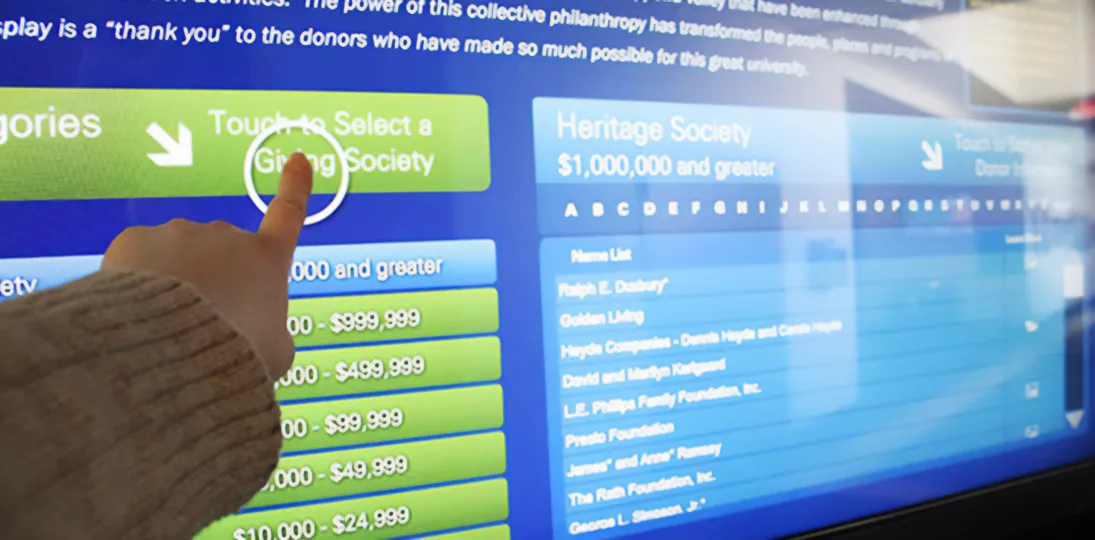
- An interactive touchscreen experience that lets visitors search and sort donors, watch testimonials, read mission statements, and follow links.
- A full touchscreen video wall built around a custom design that anchors a major space.
- A hybrid setup that runs as passive signage most of the day and switches into an interactive mode when someone approaches.
Most installations are custom-built to match an organization’s brand and goals, but the underlying mechanics are well understood and don’t require reinventing anything.
Digital Donor Walls vs. Traditional Plaques
The case for digital is rarely about flash. It’s about what plaques can’t do.
Plaques are beautiful, and a well-designed brass wall communicates permanence in a way pixels cannot replicate. But plaques also have constraints that grow more visible the longer you live with them:
- New donors mean new engravings, which means dollars and lead time every time the donor list changes.
- A correction (a misspelled name, a changed title) means redoing a plate, not editing a record.
- A plaque shows a name and maybe a tier. It does not show a photo, a video tribute, a story, or a link.
- A wall designed with empty slots for “future donors” can read as half-finished; one without empty slots requires a redesign or expensive additions.
- Multiple campuses or sites mean multiple installations, each maintained separately.
A digital donor board addresses all of those and adds capabilities plaques never had to begin with. The next section gets specific about what those are.
8 Benefits of Digital Donor Recognition Displays
1. Eye-catching visual presence
People are wired to notice motion and light. A bright, animated screen will draw a passing visitor’s eye in a way a wall of metal nameplates, however appealing, simply doesn’t. That matters because the first job of donor recognition is to be seen.
HD displays also handle text more legibly than engraved surfaces, and they fit more information into the same physical footprint. You can show what a brass wall could never show: a video of a donor talking about why they give, a photograph of the program their contribution funded, a brief animated sequence on mission progress.
2. Lower lifetime cost than plaques
Yes, there is upfront cost: hardware, software, design, installation. Compared to a fully built-out custom plaque wall, the initial investment is often comparable. The difference shows up over time. Adding a new donor to a digital board takes minutes and costs effectively nothing in materials. Adding one to a plaque wall means commissioning a new plate, scheduling installation, and absorbing whatever the engraver charges. Over five or ten years, those costs compound. Most organizations that move to digital report saving both money and the project-management overhead that came with every plaque update.
3. Flexible tiers that motivate giving
Recognition isn’t only about gratitude. It also functions as an incentive. Research on selective recognition has found that highlighting top donors creates what economists call “tournament-like incentives”, which can shift giving behavior upward, because donors aspire toward the visible top tier. The same research suggests recognizing the lowest tier can have the opposite effect, encouraging participation among those who might otherwise give little or nothing.
Digital boards make tiering more flexible. Rather than fixed dollar bands etched into metal, you can name your tiers (Founders, Patrons, Benefactors, or whatever fits your culture) and adjust them as your campaigns evolve. The visual hierarchy can shift, too: Gold tier donors get larger placement or richer multimedia treatment, while lower tiers still get visibility but in a different format.
4. Storytelling that connects donors to impact
Donors give for reasons that go beyond tax deductions. Surveys consistently find that donors are motivated by passion for the cause, a belief that the organization depends on their support, and personal connection to someone the mission affects. A meaningful share of donors (around 42% in some surveys) say personal stories from beneficiaries directly influence their decision to give.
A donor board with video and photo capacity can carry those stories. You can run filmed testimonials from donors and from beneficiaries, before-and-after photo essays of funded projects, or brief written narratives about a particular gift’s impact. None of this is possible on a plaque. All of it is possible on a screen running content you can update whenever a new story is ready.
5. A natural home for your mission
A donor board doesn’t have to be only about donors. You can rotate any content through the playlist or make them available via touchable buttons: mission statements, upcoming events, fundraising goals, data visualizations of progress to date. A thermometer animation showing how close you are to a capital campaign goal is more compelling than a flat number, and it lives naturally on the same screen that just recognized your top tier.
This kind of layered content turns the donor wall from a passive monument into an active communication surface. The donors get recognized; the mission gets reinforced; the next campaign gets a head start with anyone who happens to walk by.
6. Interactivity and touchscreen options
Touchscreens aren’t right for every installation, but where they fit, they unlock capabilities that nothing else does. Visitors can search by name, sort by category or donation amount, watch longer videos, read detailed bios, follow links to program pages, and in some setups sign up for newsletters or make a contribution on the spot.
Even without touch hardware, you can build in soft interactivity through QR codes. A QR code on screen takes a visitor’s phone directly to a donation page, an event registration, or a story page. Given that roughly 45 percent of online donations now come from mobile devices, that bridge from screen to phone is worth designing intentionally.
For older audiences, who may be slower to pull out a phone, a touchscreen with large, clear navigation and voice support can actually be more accessible than QR codes. The best approach is often to support both.
7. Data-driven updates without a vendor
Once a digital donor board is built, the day-to-day update workflow can sit entirely with your team. Most digital signage platforms can pull donor data from a structured source: XML, JSON, or even a Microsoft Excel spreadsheet. When someone updates the database, the donor board updates automatically.
This is the part IT teams and content managers tend to appreciate most. The donor wall becomes a data-driven display rather than a hand-built creative project that needs a designer every time a name changes. For organizations with multiple campuses or office locations, a central CMS keeps branding and messaging consistent across all sites while still allowing local users to add their own content where appropriate.
8. A consistent part of your omnichannel strategy
A donor board is one channel among many. Most donors interact with an organization across email, social media, direct mail, the website, in-person events, and on-site visits. The donor wall sits in that mix as the on-premises expression of your recognition strategy.
The practical implication is that the donor board’s design, tone, and content should match what donors see everywhere else: same brand, same color palette, same typographic voice, same story arcs. Consistency across channels does meaningful work for recognition and retention, and it’s much easier to maintain when the donor board is managed in the same CMS that powers your other internal communications.
How Digital Donor Boards Engage Staff, Not Just Visitors
Donor boards are usually framed as public-facing, and that’s their primary audience. But it’s worth noting the secondary internal value. Staff who walk past a donor wall every day see, repeatedly, who is funding the work they do. That visibility can reinforce a sense of mission, make abstract budget realities concrete, and surface gratitude that might otherwise live only in development team emails.
In healthcare facilities, for example, clinical staff often don’t have direct contact with major donors. A well-designed donor board in a staff corridor or atrium puts faces and stories in front of people whose work those gifts make possible. The same principle applies in academic settings, arts organizations, and any other context where staff and donors operate in mostly separate worlds. When donor recognition is seen in tandem with employee communications, there’s a quiet coherence to the message: this is who we are, this is what we do, this is who makes it possible.
How to Plan a Digital Donor Wall
A few things tend to determine whether a donor board project goes smoothly or stalls:
Gather your content first. Donor information (names, tier assignments, photos, bios, video clips, written stories) takes time to collect. Reaching out to donors, getting written permission, sourcing high-resolution images, recording or editing video: all of this should happen before design begins. Projects that try to gather content in parallel with build-out almost always slow down, sometimes considerably.
Decide on data structure early. If the screen is interactive, how do you want viewers to browse? By last name? By tier? By campaign year? By area of impact? The structure of your underlying database should match the navigation you want to offer and changing that structure midway through a project is expensive.
Plan for permissions and updates. Who on staff will own the day-to-day updates? Who has approval authority for new content? Where does donor data live, and how does it sync with the signage system? These workflow questions are easy to skip in the design phase and painful to address after launch.
Respect donor privacy. Not every donor wants public recognition, and some have explicit confidentiality preferences in their gift agreements. Never publish donor information without permission. For donors who prefer a handwritten note or private thank-you, a digital board still gives you the option to highlight their gift anonymously, or to feature their story (with their consent) in a way that centers on impact rather than the donor’s identity.
A note on accessibility: donor boards in public spaces should meet the same accessibility standards as any other public-facing communication. Sufficient contrast, readable font sizes, standardized icons, and keyboard or voice navigation options on interactive kiosks are all worth specifying upfront.
Digital Donor Board Software and Data Integration
For the IT readers in particular, a few specifics worth knowing:
Donor boards typically run on the same media players as the rest of a digital signage network, so they don’t introduce new hardware categories. Touchscreens add some complexity – commercial-grade displays with embedded touch, ruggedized for public use, are the standard, and they generally play nicely with mainstream CMS platforms.
Data integration is usually the most consequential technical decision. A donor database that exports cleanly to XML, JSON, or a structured spreadsheet will save enormous time in the long run. If your development team uses a fundraising platform like Raiser’s Edge, Salesforce NPSP, or a similar CRM, the question to ask early is how that platform’s data can flow to the signage system on a regular schedule. Some integrations are out of the box; others require a middleware layer or a custom script. Either way, the goal is the same: a single source of truth for donor data that updates the screens automatically, rather than a parallel list maintained by hand.
For multi-site organizations, centralized content management with site-level publishing rights is the configuration to look for. You want headquarters to control brand and structure, while individual campuses or hospitals can publish locally relevant content – a new wing’s donor list, a regional campaign, an event flyer. Most enterprise-grade signage platforms support this kind of role-based access; it’s worth confirming during evaluation rather than discovering after deployment.
Turning Donor Recognition into an Ongoing Relationship
Digital donor boards aren’t a flashier replacement for plaques. They’re a different kind of communication tool – one that turns recognition into an ongoing relationship rather than a one-time engraving. They give donors richer acknowledgment, give prospective donors a more complete picture of why your work matters, and give the people running your signage system a manageable, sustainable workflow.
If you’re already running a digital signage network for internal communications, wayfinding, or lobby displays, adding a donor board is more of an extension than a new project. If you’re not yet running one, the donor recognition use case is often a strong place to start, because it makes the business value concrete and visible to leadership in a way that more diffuse internal communications sometimes don’t. A well-executed donor wall is the kind of installation a CEO points to during a tour, which tends to make subsequent signage investments easier to justify.
The fundamentals are straightforward: thank the donors you have, tell their stories, share your mission, and make it easy for the next person to give. Digital just gives you more, and better, tools for doing all four – and a system you can keep using long after the screens themselves are paid off.